You are staring at a stubborn padlock on your gym locker or shed door, and the combination is completely gone from your memory. This frustrating scenario happens to millions of people who rely on mechanical number locks for daily security without realizing their vulnerability.
Standard 3-digit and 4-digit locks often rely on mechanical tolerances rather than complex cryptography, making them easy to bypass with simple techniques. This guide teaches you how to pick a number lock using tension or a basic paper clip to recover access in minutes.
Decode Wheel Resistance Using Shackle Tension

The most reliable method to open a locked padlock involves feeling for mechanical play within the dials while applying steady pressure. This technique exploits the internal wheel-and-gate system found in nearly every mechanical combination lock on the market.
When a specific number aligns with the internal gate, the shackle drops slightly into the gap, reducing resistance on that dial. You will feel a distinct click or a sudden looseness that indicates the correct position for that specific wheel.
Apply Constant Light Pressure to the Shackle
Pull the shackle outward gently to create internal friction without binding the mechanism completely. The ideal tension feels light and steady, similar to holding a small bird without crushing it.
Maintain this exact pressure level throughout the entire process to ensure you do not miss subtle feedback changes. Any fluctuation in your grip can mask the resistance shifts you are trying to detect.
Test Each Dial for Binding and Play
Gently wiggle each dial back and forth between adjacent numbers while keeping tension on the shackle. The dial that feels loosest or clicks at a specific number is likely aligned with its internal gate.
Dials with high resistance are still misaligned because their solid sides are blocking the shackle path. Start with the dial showing the most play as this is usually the first digit of the combination.
Rotate Dials to Detect the Drop Point
Slowly turn the loosest dial from zero to nine while maintaining your outward pull on the shackle. Listen and feel for a distinct click, a sudden drop in resistance, or a microscopic movement of the shackle itself.
Mark the number where this occurs immediately as it represents your first correct digit. Once set, the overall tension on the lock should decrease slightly, making the next dial easier to test.
Repeat the Process for Remaining Dials
Fix the first number in place and move to the next dial to repeat the wiggle and rotate process. Reapply tension and watch for the same signs of looseness or clicking that you found on the first wheel.
As each wheel aligns correctly, the lock becomes progressively looser and easier to manipulate. For 4-digit locks, this sequential unlocking makes identifying later digits significantly faster.
Pro Tip: If a dial gives weak feedback, skip it and return after aligning others. Sometimes earlier misalignments mask the signals from later wheels.
Verify the Full Combination Sequence
After setting all dials to your detected numbers, release the shackle tension slowly to see if the lock opens. If the lock remains shut, try rotating suspect dials plus or minus one number since false gates are common.
Recheck your tension level to ensure it was not too heavy or too light during the process. Many locks open within a few tries once you find the correct sequence and ensure wheels are fully seated.
Use a Paper Clip to Find Internal Gate Positions
When tension alone fails to provide clear feedback, a simple tool can dramatically improve your detection accuracy. The paper clip method bypasses ambiguous tactile sensations by directly probing the internal wheels through the shackle hole.
This technique works because the tool physically drops into the gate when aligned, giving you clear auditory and tactile confirmation of the correct position.
Prepare a Straightened Metal Probe
Take a standard metal paper clip and straighten one end completely while leaving a small bend at the other end for grip. The probe tip must be thin and rigid to effectively contact the internal wheels without bending.
You can also use a sewing needle, guitar string, or SIM card ejector tool as an alternative. Avoid flimsy wires that might bend inside the lock and jam the mechanism permanently.
Insert the Tool Through the Shackle Hole
Locate the small gap where the shackle enters the lock body and insert the straightened end of your tool. Push it in until it contacts the first internal wheel, angling it so it rests against the wheel surface.
Ensure the tool is not wedged between components but rather touching the rotating surface of the wheel. This contact point is essential for detecting the gate position accurately.
Tap and Rotate to Detect the Gate
Lightly tap the end of the paper clip with your finger while slowly rotating the top dial. Listen and feel for a sudden click, a drop sensation where the tool sinks slightly, or a change in the tap sound from hollow to solid.
When the gate aligns, the tool will fall into the notch, providing a clear signal. This detected gate position is critical, though it is not yet your final combination number.
Warning: Do not force the tool inside the lock. Excessive pressure can jam the wheels or damage the internal mechanism permanently.
Calculate the Real Combination from Gate Data
The gate position you found is not the unlock position, so you must perform a simple calculation. Most locks require rotating the dial two clicks past the detected gate to align it with the shackle release point.
Subtract two from each detected number, wrapping around if the result is negative. For example, if you detected a gate at 9, subtracting 2 gives you 7 as your potential combination number.
If the lock does not open, try adding three clicks instead of subtracting two. Some older models use a 3-click offset, so testing both variations is a necessary step.
Expert Note: Master Locks commonly use a 2-click offset, while generic brands may vary. Always test both offsets systematically if the first attempt fails.
Recognize False Feedback and Fix Common Errors
Even experienced users fail when they misread signals from false gates or worn mechanisms. Understanding what is happening inside the lock helps you avoid wasted time and frustration.
Some locks have shallow notches or machining flaws that mimic real gates, leading to incorrect combinations. Distinguishing between real and false gates is essential for success.
Distinguish Real Gates from False Ones
True gates show consistent drops across multiple attempts and noticeable shackle movement. False gates provide inconsistent feedback and do not improve the overall tension on the lock.
If you are stuck, reset the dials and re-scan, focusing on the clearest and most repeatable drop. The true gate will always feel more distinct than a manufacturing flaw.
Adjust Tension If Feedback Is Weak
If you feel no movement, your tension level is likely incorrect and needs adjustment. Too much pressure makes all dials feel stiff, while too little pressure results in no resistance change.
Reapply tension gradually until you feel binding on misaligned dials and looseness on correct ones. Finding this sweet spot is crucial for detecting the subtle mechanical cues.
Handle Worn or Damaged Lock Mechanisms
Older or dropped locks may have misaligned wheels that make detection difficult. Gaps may be wider, clicks less distinct, and wheels may skip or stick during rotation.
Use the paper clip method for clearer detection on these difficult locks. Test combinations in a plus or minus one range around your suspected numbers to account for wear.
Master Lock 878 Opens Like the 875 Model
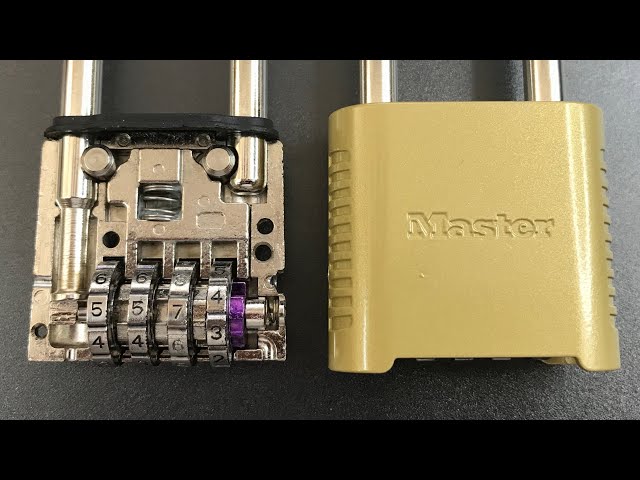
Despite marketing claims, the Master Lock 878 with four digits is just as vulnerable as the older 875 model. Testing confirms identical decoding behavior, proving that design improvements often fail to address core mechanical flaws.
Case Study: Cracking the 878 in Six Minutes
Using tension-based manipulation, testers identified the first digit as 5 due to clear looseness under pressure. The second dial showed the strongest resistance drop at 2, while the third allowed a slight shackle shift at 7.
The fourth dial completed the sequence at 9, revealing the combination 5-2-7-9. No special tools were needed, only consistent tension and attention to dial play.
This proves that as long as there is tactile feedback, the lock can be decoded regardless of marketing claims. The fundamental vulnerability remains in the mechanical linkage between dials and the shackle.
Unlock 3-Dial and 4-Dial Locks Quickly

Regardless of the digit count, the process remains the same for most standard locks. Practice on common configurations to build speed and accuracy in your technique.
3-Dial Lock Success Pattern
Tested on a generic brass combination lock, the top dial clicked under tension at number 5. The middle dial felt loose at 8, and the bottom dial opened the lock at 2.
The resulting combination was 582, found without any prior knowledge of the code. This pattern holds true for most basic 3-digit locks found in schools and gyms.
4-Dial Lock Decoding Flow
On an unmarked 4-wheel lock, the first dial had clear play at 8, and the second dropped noticeably at 9. The third allowed a body shift at 0, and the fourth released the shackle at 1.
The final combination was 8901, found in an average time of seven minutes and twenty-three seconds. Using a tape marker on the shackle can help you spot the microscopic shifts faster.
Adapt Methods for Specialty Lock Types
Not all number locks use a standard shackle, as older designs like Chinese brass barrel locks work differently. The principle remains the same, however, since aligned gaps enable movement.
Unlock 5-Dial Antique Brass Locks
This type uses rotating barrels with internal notches that allow the two halves to slide apart when aligned. Apply gentle side pressure to separate the lock body while rotating each dial slowly.
Feel for reduced resistance, as each correct dial allows slight sliding movement. Progressively align all five dials until the lock separates, using magnification if needed due to the small size.
Caution: These locks are fragile, and excessive force can strip internal threads or crack casings. Use extreme precision and light pressure.
Understand the Wheel-and-Gate Flaw

These methods work because mechanical combination locks are designed for convenience rather than high security. Understanding the internal mechanics helps you visualize why the techniques are effective.
How Wheels and Gates Function
Inside every standard padlock are metal wheels, with one per dial, and each has a single notch called a gate. When locked, the gates are misaligned, and solid parts block the shackle from retracting.
When unlocked, all gates align with the shackle path, allowing it to retract freely. Manufacturing requires small gaps, and when tension is applied, the shackle presses against the wheels to create detectable feedback.
Feedback Sources You Can Exploit
- Tactile: Feel for dial looseness or a resistance drop.
- Auditory: Listen for clicks when a tool hits a gate.
- Visual: Watch for shackle movement or tape shifts.
- Mechanical Play: Detect slop in correctly aligned dials.
Using multiple feedback channels increases your speed and accuracy significantly.
Avoid Common Picking Mistakes
Small errors can block your success, so stay aware of frequent issues. Avoiding these pitfalls ensures you do not waste time or damage the lock.
Wrong Tension Level Application
Over-tightening causes all wheels to bind so no dial moves freely. Under-tightening gives no feedback, making everything feel loose and unresponsive.
Practice on a known lock by opening it, scrambling the dials, and re-picking with varying tension. Find the sweet spot where you feel binding on wrong numbers and looseness on correct ones.
Misreading the Offset Calculation
Assuming the gate position is the combination is the number one error users make. Always apply a minus 2 offset first, and if that fails, try a plus 3 offset.
Test both variations systematically to ensure you cover the most common lock configurations.
Tool Jamming in the Mechanism
Pushing the paper clip too hard can wedge it between wheels and cause jams. Use light, constant pressure and withdraw the tool to reinsert if it gets stuck.
Do not twist or force the tool, as gentle tapping is all that is required for detection.
Upgrade Beyond Basic Combination Locks

If security truly matters, standard number locks are not enough for your needs. They offer zero cryptographic protection, and a determined person can open most in under ten minutes.
Better Alternatives for Security
- Keyed Padlocks: Harder to manipulate without specialized lockpicks.
- Disc Detainer Locks: Resistant to tension and probing methods.
- Electronic Combo Locks: No tactile feedback and often include anti-tamper alarms.
- High-Security Padlocks: Feature reinforced shackles and anti-drill pins.
For gym lockers, convenience may justify the risk, but upgrade for valuables or long-term storage.
Reset Your Own Lock Safely
If you regain access, reset the combination immediately to prevent future issues. Follow the proper steps to ensure your new code is set correctly.
Steps to Change the Code
- Open the lock with the current combination.
- Pull the shackle up and rotate it 90 or 180 degrees into set mode.
- Turn dials to your new desired code.
- Return the shackle to the normal position.
- Test the new code three times before relying on it.
Warning: Never attempt reset procedures on a locked, unknown-combination lock, as this requires prior access.
Test Lock Security Post-Reset
Set the lock to 0-0-0-0, engage change mode, and scramble dials without looking. Apply the decoding method, and if you recover the combo, the lock is insecure.
This is a valid security audit for personal use to understand your lock’s vulnerability.
Frequently Asked Questions About Picking Number Locks
Can you pick a number lock with just your hands?
Yes, you can pick many standard number locks using only your hands by applying tension to the shackle. This method relies on feeling for resistance changes and clicks as you rotate the dials.
What tool works best for opening combination locks?
A straightened paper clip is the best tool for beginners due to its rigidity and availability. Sewing needles or guitar strings also work well for probing internal gates through the shackle hole.
Why does my lock not open after finding the gate positions?
The gate position is rarely the final combination number, so you must apply an offset. Try subtracting 2 from each detected number, or add 3 if the first attempt fails.
Are 4-digit locks harder to pick than 3-digit ones?
No, 4-digit locks follow the same mechanical principles and are often easier because each aligned wheel reduces tension for the next. The process simply takes slightly longer due to the extra digit.
Is it legal to pick a lock that I own?
Yes, it is completely legal to pick or decode a lock that you own or have explicit permission to access. Unauthorized access to property you do not own is illegal.
Key Takeaways for Learning How to Pick a Number Lock
Standard mechanical number locks rely on physical tolerances rather than true security, making them vulnerable to simple manipulation techniques. By applying light tension or using a paper clip probe, you can detect internal gate positions and decode the combination in minutes.
Always remember that the detected gate position requires an offset calculation, typically minus two, to reveal the actual combination. Practice these methods on your own locks to understand their limitations and consider upgrading to high-security options for valuable items.
Now that you know how to pick a number lock, test these techniques on your own gym or shed lock to recover access safely and legally.